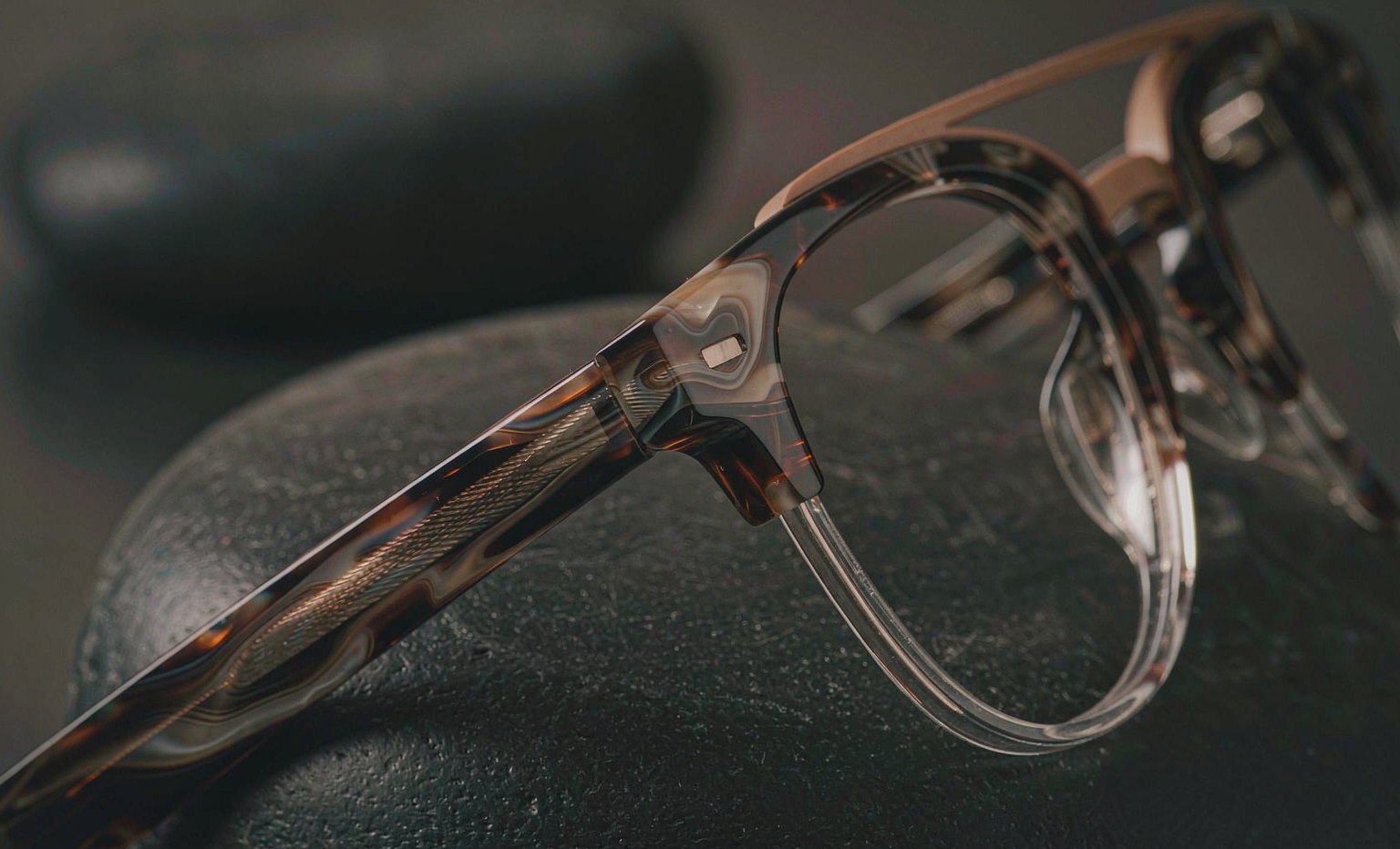
We manufacture acetate, titanium and metal eyewear for independent brands and optical houses across Europe, the United States, Japan and Korea — from first drawing to CE-and-FDA-ready shipment.

Most factories quote a price per pair and hand you a catalogue to choose from. We work the other way round: from your technical drawing, your reference frame, or a mood board we help you turn into geometry.
Eighteen years of export work has taught us that the difference between a good frame and a forgettable one is rarely the design. It is the hinge pocket depth, the seasoning time of the block, the twenty-third minute in the polishing barrel.
Italian cellulose acetate, seasoned, milled and polished by hand.
View collection →Pure and beta titanium, laser-welded, under 11 grams.
View collection →Stainless steel and monel, electroplated and verified per batch.
View collection →Polarised, gradient or mirror lenses fitted to your specification.
View collection →Start from an existing mould to shorten development, then adapt colour, material and hardware. Or use these as a reference for tolerance and finish.
Your sketch becomes manufacturable geometry. 3D modelling, lens curve selection, weight distribution and tolerance stack-up — resolved before a block is cut.
↗ 02In-house CNC tooling, 3D-printed prototypes in 48 hours, and functional samples in your specified acetate or titanium within 7–10 days.
↗ 03Eight CNC cells and a 220-person line, running at 1.2 million pairs a year. Every batch carries a material lot and operator record.
↗ 04Tumbling, hand polishing, pad printing, laser marking, lens fitting, final QC — and the technical file your market requires.
↗
Acetate keeps moving after it is cut. We season every block for three weeks, mill the hinge pocket rather than drill it, then tumble the front for 36 hours before it is touched by hand. It is slower. It is also why a frame still folds flat after five years.
Eyewear is a regulated product in every market we ship to. We build the technical file alongside production, not after it — the single most common reason a container sits at port is paperwork that arrives late.
Process control, traceability and corrective action across every production cell.
Documentation structure for markets that classify optical frames as medical devices.
Sunglasses as PPE, with EN ISO 12870 frame testing and EN 1811 nickel release.
Drop-ball impact testing with retained records and compliant labelling.
Per-shipment inspection records to the tolerance regime Japanese buyers expect.
Test coordination and documentation for Korean market registration.
Send a drawing, a reference frame or a mood board. Within three working days you will have a feasibility note, tooling cost and a sampling schedule.